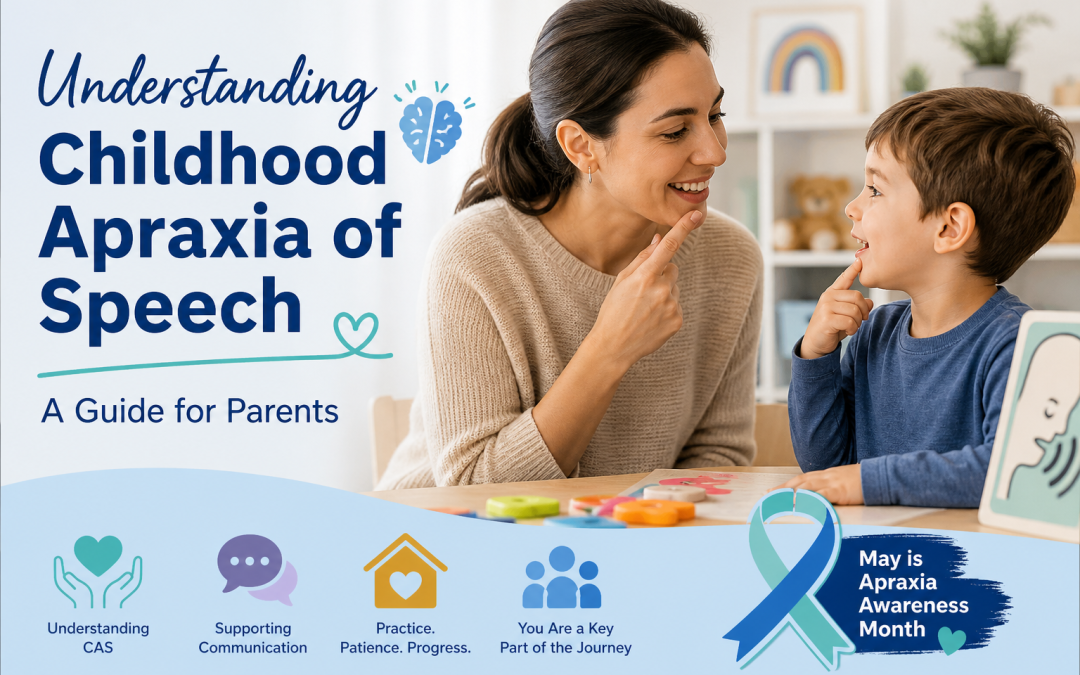
If your child is having trouble speaking clearly, you might feel unsure about what’s going on or what to do next. One possible explanation is Childhood Apraxia of Speech (CAS), a motor speech disorder that affects how children plan and produce speech. CAS is a relatively uncommon speech disorder where a child has difficulty making the precise movements needed for speech. It is not caused by weak muscles. Instead, the challenge lies in how the brain communicates with the muscles used for speaking.
In order to speak, the brain has to create a plan that tells the lips, jaw, and tongue how to move to form sounds and words. In children with CAS, this planning process is disrupted. As a result, speech may sound inconsistent, and children may struggle to say sounds, syllables, or words clearly and smoothly.
It’s important to know that many children with CAS understand language and know exactly what they want to say. The difficulty is in getting those words out.
What does CAS look like?
Children with CAS may:
- Have trouble producing clear sounds or words
- Say the same word differently each time
- Struggle with longer or more complex words
- Have difficulty with the rhythm and flow of speech
Because communication can be challenging, this can sometimes lead to frustration for both the child and their family.
How can we support communication?
While working on speech is the long-term goal, many children benefit from using additional tools to communicate more effectively in the meantime.
These can include:
- Sign language
- Augmentative and Alternative Communication (AAC) devices
Some families worry that using these tools will prevent their child from talking, but research and clinical experience show the opposite. These supports actually help reduce frustration, build confidence, and encourage communication. As speech skills improve, children often rely less on these tools over time.
Progress with CAS takes time, consistency, and teamwork. One of the most important parts of therapy happens outside of sessions. Parents and caregivers play a key role by:
- Practicing speech activities at home
- Encouraging communication in everyday routines
- Helping create a positive, supportive environment
Speech therapy for CAS often includes “homework” activities that reinforce what your child is learning. Consistent practice helps the brain build stronger connections for speech planning and production. Improvement with CAS doesn’t happen overnight. It requires patience, repetition, and dedication. However, with the right support and consistent practice, children can make meaningful progress in their communication skills.
—-
May is Apraxia Awareness Month, a great time to learn more and help others understand CAS. Sharing information and experiences can make a big difference for families navigating this journey.
If you have concerns about your child’s speech, connecting with a speech-language pathologist can help you better understand your child’s needs and the next steps forward.
